
Speed Chain Conveyor + Modular Workstations: How to Build an Assembly Line That Fits Your Process(2)
3. What a Real Project Looks Like: Configuration and Changes
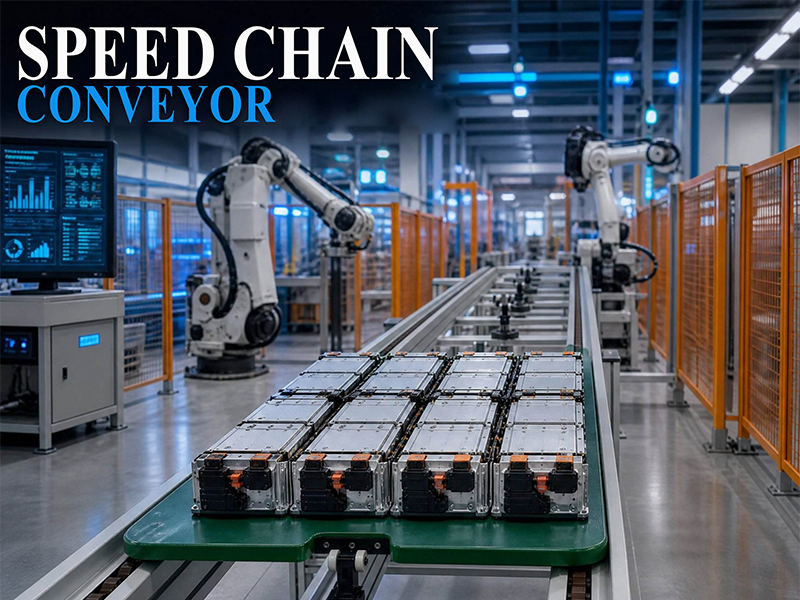
Continuing from the previous part, let us take a real case and see what a double-speed chain conveyor combined with modular workstations actually delivers. This conveyor line assembles community-use battery packs. It was delivered to a customer in Austria, and from order placement to shipment took about 40 days.
The process is divided into five workstations:
|
No. |
Workstation |
Type |
|
1 |
Battery pack pick-and-place onto the line |
Pneumatic gripper loading |
|
2 |
Lid placement |
Manual |
|
3 |
Clamping and fixing |
Clamping machine |
|
4 |
Cover pressing |
Pneumatic press |
|
5 |
Laser welding |
Laser welder workstation |
The conveyor runs at a cycle time of 50 seconds per piece, with 10 pallets in total.
What the line had to solve. The battery packs are heavy, and moving them from one operation to the next was done by hand — exhausting work, and slow over a long shift. The real difficulty lay in clamping: bringing the battery pack to its correct position demands a large clamping force, applied evenly and at the right place, which an operator cannot repeat reliably. Once the pack sits wrong, the laser weld position downstream is off as well.
What changed after the line went in. The battery pack is placed on a locating fixture on the pallet, and the clamping is carried out at the workstation, where the pallet itself is clamped and located during the operation. “Sitting in position” therefore becomes a repeatable action: the weld position depends on the fixture, not on how well the operator happened to clamp it that shift. Two manual handling positions were removed from the line, and the time spent on clamping also came down.
What did not change. The process steps themselves are the untouched original ones. The line only reduces manual work and raises efficiency and yield; it neither removes nor adds operations, so output stays consistent with the original — and quality is, if anything, more dependable.
4. Where These Projects Go Wrong
Most of the trouble on a line like this clusters around a handful of points.
Pallet positioning accuracy. Workstations that need high repeatability — robots, laser heads, measuring vision — cannot get that accuracy from a standard double-speed chain conveyor built with standard profiles. The answer is to add locating pins and lift-and-clamp units only at those stations, not along the whole line. Adding them at the design stage and retrofitting them afterwards are very different in cost, because a retrofit usually means reworking the profiles.
Incompatible communication protocols. An old welding machine, a new vision system and a third-brand conveyor PLC can each work perfectly on its own and still not talk to one another. The fix here is procedural rather than technical: agree on one fieldbus and one handshake format before the order is placed, and write both into the purchasing specification.
No room left for later changes. A conveyor built to exactly fill today’s process has nowhere to put tomorrow’s new station. Build the frame from standard module sections and leave one empty station: it costs very little extra at the time of purchase, and it saves reworking the profiles later.
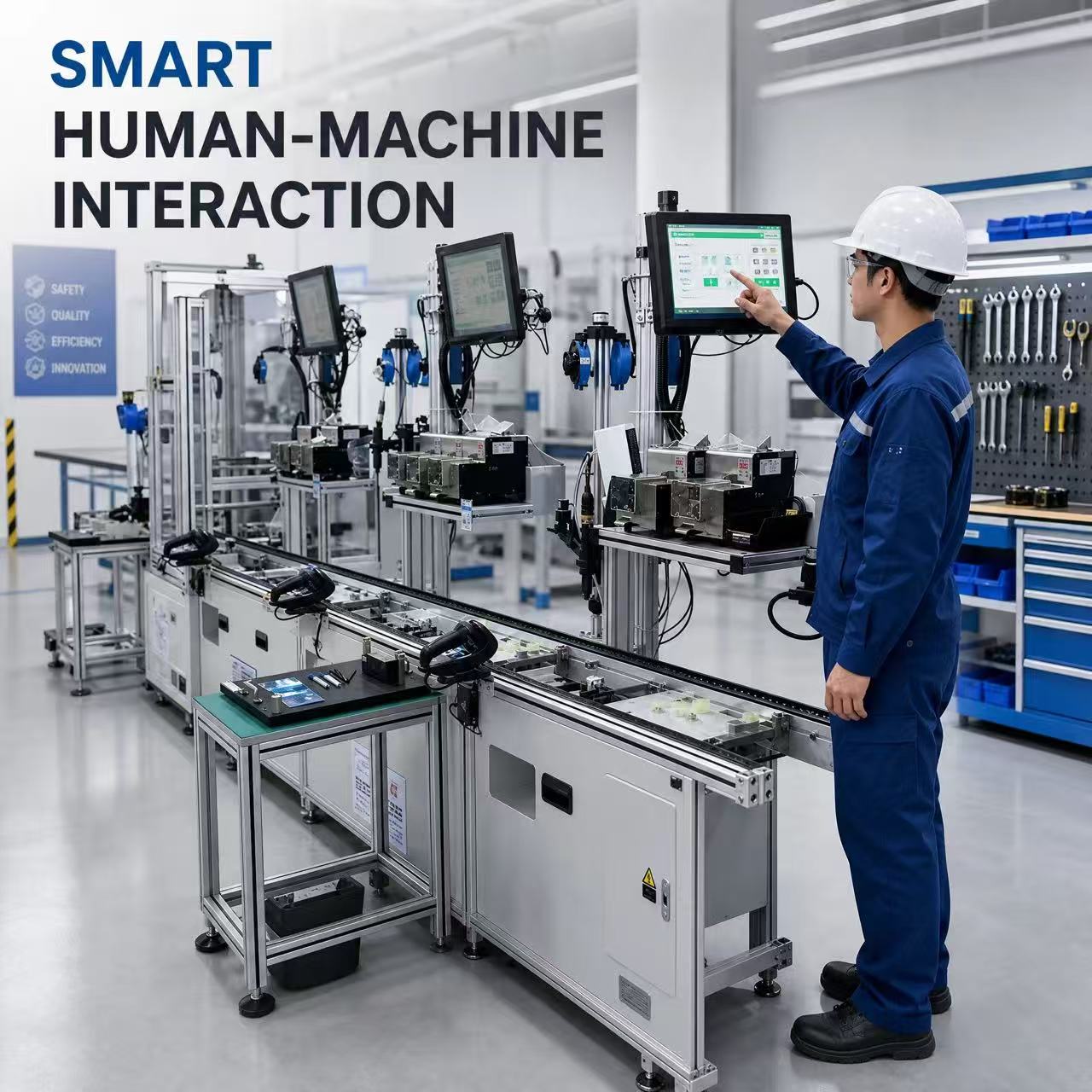
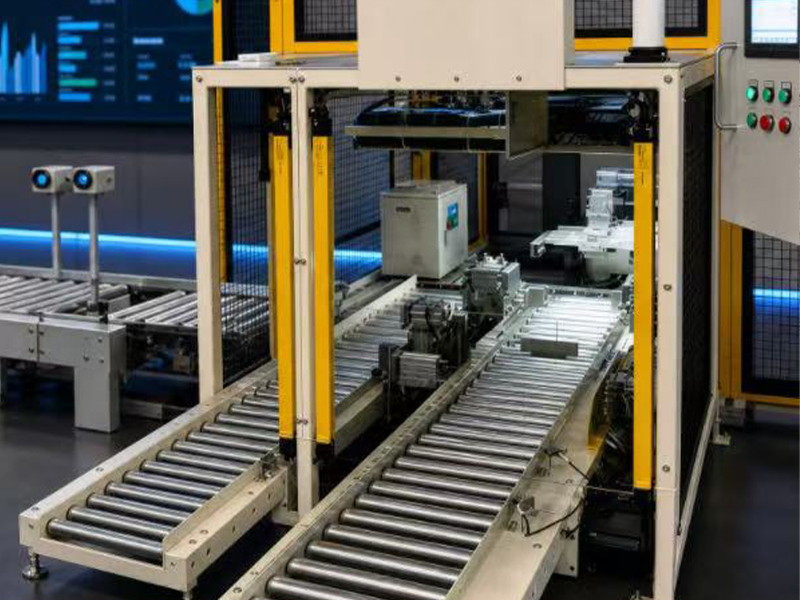
Human and automatic stations on the same line. When operators and automated stations work on one line, the safety design — light curtains, interlocked doors and a written rule on who may enter the line area — must cover both cases at once. That is both a safety requirement and, usually, an audit requirement.
5. Which Industries Fit Best
Assembly work that suits a double-speed chain conveyor with modular workstations usually shares a few traits: the operations are repeatable, the batch size is medium, and each operation can be separated by pallets instead of keeping the part in one fixture from start to finish.
- Electronics and home appliances — screw fastening, testing, laser marking, vision inspection.
- Automotive components — welding, press fitting, leak testing, final inspection.
- New energy and lithium batteries — module assembly, dispensing, withstand-voltage testing.
- Hardware and tools — assembly, marking, packaging.
- Medical consumables and food — stainless-steel or plastic chain versions, with profile frames that can be washed down.
Where the product changes often but the process sequence does not, a conveyor with modular workstations is usually the cheapest way to absorb that variation, because what changes is the pallet and the recipe, not the mechanical layout.
6. What to Expect Next
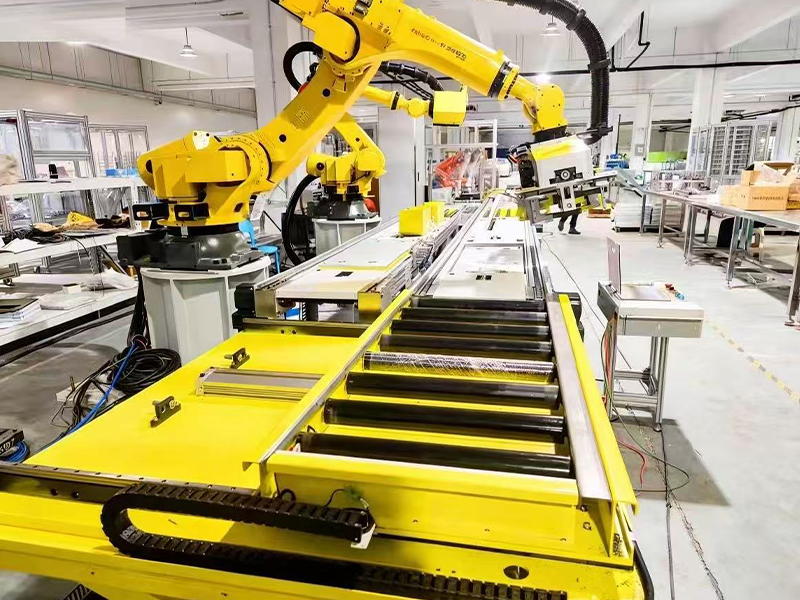
Robotic cells entering the pallet path. A six-axis or collaborative robot can be placed between two manual stations to take over the heaviest or most repetitive operation. Nothing changes for the conveyor, because the stop-and-release signals it receives are the same as those from a manual station. Today’s real constraint is fixture design and the safety space around the arm, not the line itself.
Vision inspection with AI. Camera hardware and inspection models are both cheaper and more capable than before, so moving from “one sample check at the end” to “a check at every station” is now affordable even for small and medium manufacturers. It does, however, raise the bar for pallet positioning on the conveyor, because a camera tolerates position variation less well than a person does.
Precision assembly with ultrasonic positioning. On very small parts, ultrasonic positioning guided by vision is beginning to replace mechanical fixtures. It can be connected to a double-speed chain conveyor, but it also raises positioning requirements — and the discussion comes back to lift-and-clamp units and pallet locating sleeves.
Humanoid robots. Humanoid robots are currently at the pilot stage, mainly for handling and loading or unloading. They need the same interface that the conveyor already provides to manual stations, so the line itself is not the bottleneck. Planning a line around humanoid robots is still too early — but the interface question already has an answer.
7. Is Your Factory a Fit?
A double-speed chain conveyor with modular workstations is not the right answer for every assembly process.
Usually worth installing when:
- the product takes more than two or three operations, always in the same sequence;
- volume is enough to keep every station busy, but not high enough to justify a dedicated fully automatic line;
- parts already have to be moved repeatedly between operations, and that handling is a visible cost;
- per-unit traceability has value, whether to the customer or to the process itself;
- someone in the plant can maintain PLC-controlled equipment and the stations on the line.
A workbench plus carts is the better fit when:
- the product changes so often that fixtures on the pallets have to be rebuilt constantly;
- volume is low, or swings widely from month to month;
- one operation is so long that it dominates the takt of the whole line;
- parts are too large or irregular for a pallet to hold;
- the floor space cannot accommodate a conveyor layout;
- no one can maintain the control system and the stations on the line.
There is also a middle option. A double-speed chain conveyor with manual stations and manual transfer between them, without automatic stoppers and without an identification system. This captures most of the gains in flow and handling, at lower cost and with far fewer interfaces to design. For a factory not yet ready for the fully interlocked version, it is a reasonable starting point that can be upgraded as volume grows.
Want to upgrade or improve an existing line and raise its output? Send us your site conditions and process requirements, and we will give you a complete, reliable, upgrade-ready double-speed chain conveyor solution. We look forward to your enquiry.