Leave Your Message
0%

So, you’re looking to upgrade your conveyor line in 2026? Here’s the thing: it’s not about grabbing the newest shiny model off the shelf. It’s really about what makes sense for the specific job you’re doing. For instance, if you’re moving cartons along a line, you’ll want rollers that flow freely. But when you’re dealing with heavy pallets, you need a beefier frame and rollers spaced just right to handle the weight. Mark Ellison, a materials-handling engineer, sums it up nicely: “Choose the roller path for the load, not just the floor plan.” That’s a pretty solid rule of thumb, and it’s exactly what we’re going to keep in mind as we break down the top roller conveyor types and how they’re actually used in the real world.

So, a straight non-powered roller conveyor? That's your go-to for simple, level moves—nothing fancy, just straight-line transfers. Then you've got the curved ones, which are pretty neat for guiding cartons around a tight corner without a lot of fuss. Now, if you need to move stuff between different heights, an inclined conveyor can do the job, but honestly, you'll want to test the slope and the load carefully—it's not a set-and-forget thing. And here's a cool one: flexible roller conveyor sections. They can stretch or bend to fit whatever your work area throws at them. Compact, adaptable—not magic, but close enough. Finally, there's the double-layer roller conveyor. Smart use of vertical space, sure, but you've gotta keep access and clearance in mind—otherwise, you might end up with a headache later. Trust me on that one. So, a loop roller conveyor is basically your go-to if you want stuff to keep moving in a circle without any hiccups. And a frame-type roller conveyor? That one's more about being rock-solid for when you've got a specific path in mind—like, it's built to handle the defined routes.

Honestly, there's no one-size-fits-all setup when it comes to conveyor systems. You've got to think about roller diameters, how sturdy the frame is, what you're actually moving—like carton size—and how fast you're pushing things through. I've seen small boxes kind of teeter-totter over wide gaps, and bulky items can really stress out flimsy supports. Plus, real warehouses have those awkward corners, and let's be real—people don't always work in perfect, consistent patterns. Those little quirks are super easy to miss on a spec sheet. So, in this overview, I'll walk you through the main types of systems, point out where each one shines, and call out the trade-offs you should double-check before you commit to anything.
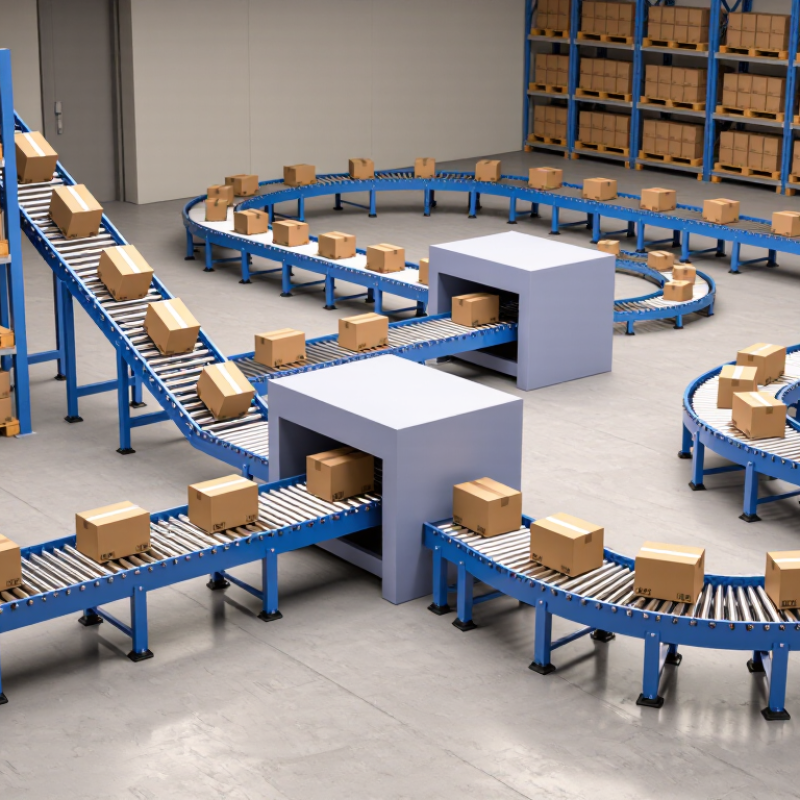
What Are the Top Roller Conveyor Types in 2026?

Roller Conveyor Basics: ANSI/CEMA 401 and the Three-Roller Support Rule

ANSI/CEMA 401-2019 covers non-powered roller conveyors, including standard dimensions and design guidance. It gives engineers a shared starting point, not a substitute for checking the load, frame, and operating conditions. For a rigid unit load, the three-roller support rule means at least three rollers should support it at any point. That helps prevent tipping and uneven loading. Measure the load’s contact length, not just its overall length. Small cartons can behave differently when their bases are flexible.

The rule needs judgment. Roller spacing, load weight, speed, and conveyor transitions all matter; three contact points alone do not guarantee smooth travel. MHI’s 2024 Annual Industry Report surveyed more than 2,000 supply-chain professionals and reported that 55% planned to adopt robotics and automation within five years. That trend makes reliable conveyor interfaces more important, though the statistic is not a roller-specific performance measure. Powered roller conveyor systems may need separate checks for drive zones and controls. A Telescopic roller conveyor adds extension points, while a Curved roller conveyor can shift load contact toward one side. Double-layer roller conveyor layouts need clearance checks between levels. For a Heavy-duty roller conveyor, verify roller capacity against concentrated loads. Test real products when possible. The awkward cases teach the most.

Gravity Roller Conveyors: Typical 1–3% Slopes for Unpowered Flow

A gravity roller conveyor uses a slight incline to move cartons without a motor. A typical starting point is a 1–3% slope, adjusted for load weight, roller spacing, and surface friction. On a 1-meter section, that means roughly 10–30 millimeters of drop. Small differences matter. A light carton may stall on a shallow slope, while a heavy one can gather speed quickly. Test with the actual packages, not just an empty frame.

This Non-powered roller conveyor works well for short transfers, packing areas, and simple accumulation zones. A Manual roller line may need an operator to control spacing or guide awkward loads. Flexible roller conveyor sections can bridge temporary layouts, though their joints and supports deserve regular checks. For direction changes, a Curved gravity roller conveyor needs enough room for cartons to track without rubbing side guides. That rule is useful, but not complete. Dust, worn rollers, and uneven floors can change flow; even a carefully set incline may need adjustment.

24 VDC Motor-Driven Rollers: Zoned Control for Package Conveying

What Are the Top Roller Conveyor Types in 2026?

24 VDC Motor-Driven Rollers: Zoned Control for Package Conveying

A 24 VDC motor-driven roller system powers selected rollers within defined conveyor zones. Photoelectric sensors detect cartons and signal each zone to start or stop. This lets packages move forward without crowding the belt or constantly running every roller. At a packing station, for example, one carton can pause while the next waits in the upstream zone. The arrangement can reduce unnecessary motion and help operators manage uneven package flow. It is not automatically the best fit for every line.

Tips: Match roller spacing to the smallest carton, and check package weight against the conveyor’s rated capacity. Test sensor placement with real boxes; glossy wrapping or gaps between cartons can cause inconsistent detection. Keep access clear for cleaning and maintenance.

Before choosing a system, map package dimensions, required throughput, and stop-start frequency. Confirm that the control system can coordinate zones with upstream and downstream equipment. A quiet run during a short test is useful, but it does not prove performance across a full shift. Heat, dust, loose labels, or changing carton sizes may affect sensors and movement. Zoned control can simplify accumulation, yet poorly tuned spacing may leave cartons stalled or too close together. Measure the actual flow, then adjust one zone at a time.

Belt-Driven Live Roller: Continuous Drive for Mixed-Size Loads

Belt-driven live roller conveyors move cartons through powered rollers while allowing multiple items to travel at different speeds. A belt beneath the rollers transfers motion across the conveying zone. This can suit mixed-size loads, such as small parcels moving beside wider boxes, without requiring every roller to have its own motor. Watch the contact points. A light carton may slip if the belt tension or roller condition is poor.

For reliable operation, match roller spacing to the smallest load, and check that cartons sit on several rollers at once. Speed differences can also create gaps or bunching, so test with the actual products before setting controls. It is not a universal fix. Noise, belt wear, and access for maintenance deserve attention too.

A Flexible Roller Line or Flexible Roller Conveyor may help when routes change frequently. An Expandable Roller Line or Bendable Roller Assembly Line can support temporary loading areas, while a Non-powered Flexible Roller Line relies on workers or gravity rather than a drive belt. These systems solve different handling needs; the names can sound interchangeable, but their operating behavior is not.

Chain-Driven Live Roller: Positive Drive for Heavy Loads

Chain-driven live roller conveyors use a motor-driven chain to turn rollers beneath the conveying surface. This positive drive can move dense cartons, totes, and pallet loads with less reliance on gravity. It is useful when loads must start, stop, or accumulate in controlled zones. Keep the chain guarded.

Correct sizing matters. Check the load’s weight and base, roller pitch, conveyor width, and required speed before selecting a system. A pallet with uneven runners may not transfer smoothly, even when the drive has ample power. Not always obvious. Chain noise, lubrication, and alignment also need attention during routine maintenance. I have seen small alignment issues become persistent trouble; they are easy to overlook during initial planning.

Flexible roller lines address different layouts and transfer needs.

A Powered Flexible Roller Line can adapt to temporary work areas, while a Stainless Steel Flexible Roller Line may suit settings where corrosion resistance is important.
A Carbon Steel Flexible Roller Conveyor offers a sturdy option for many general-duty applications. A Rubber-coated Flexible Roller Line can add grip for suitable packages, but coating choice should match the load and operating conditions.

These options do not replace chain-driven live rollers for every heavy-load task. Check capacity data and test representative loads before committing.

Accumulation, Flexible, and Curved Rollers: Zero-Pressure Zones and 90° Turns

In 2026, roller conveyor choices increasingly focus on how parcels move, pause, and change direction. Accumulation conveyors use controlled zones to hold cartons without pressing them together. With zero-pressure accumulation, a sensor stops one zone while the next package continues forward. This helps protect soft boxes and keeps spacing predictable. Small gaps matter. Zone length, package weight, and sensor placement should match the actual product mix, not just a catalog example.

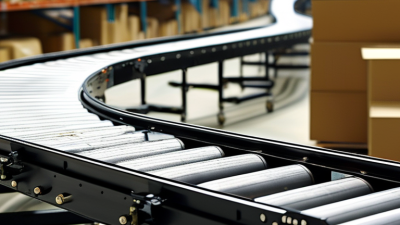
Flexible roller conveyors can extend across a loading area, then fold away when space is needed. They are useful near trailers and temporary packing stations, though uneven floors or sudden bends can make cartons drift. Curved roller sections create 90° turns without requiring workers to lift every parcel. Tapered rollers and side guides help keep loads aligned, but very small or lightweight items may still catch at the turn. The design is not foolproof; test it with real cartons, including damaged ones.

Tips: Check maximum load, minimum package size, and conveyor speed before choosing a zone or curve. Run a trial with mixed cartons and watch for skewing, stalled rollers, and noisy transfers. Keep it simple. A layout that is easy to inspect often works better than one with extra controls nobody checks.

What Are the Top Roller Conveyor Types in 2026? — Accumulation, Flexible, and Curved Rollers: Zero-Pressure Zones and 90° Turns
Conveyor type How it works Typical applications Key design considerations Main advantage Important limitation
Gravity roller conveyor Loads move along freely turning rollers, usually on a slight decline or when pushed manually. Cartons, totes, and other stable, flat-bottomed loads in packing areas, staging lanes, and short transfer sections. Check load weight and base condition; roller spacing must support the load at several points. A level conveyor will not move loads reliably by gravity alone. Simple construction with no drive motor required. Flow depends on slope or manual effort, and uncontrolled loads can gain speed on a decline.
Powered roller conveyor Motor-driven rollers move loads along the conveyor. Drive arrangements may include motorized rollers or a shared drive system. Continuous movement of cartons, totes, and suitable cases between workstations or process areas. Match drive capacity, roller spacing, conveyor width, and speed to the load range and required throughput. Provides controlled, powered transport over level runs and longer routes. Requires power and controls; the drive arrangement must suit the load and operating conditions.
Zero-pressure accumulation roller conveyor Conveyor sections are divided into independently controlled zones. Sensors and controls stop or release loads so that they can queue without intentional contact. Buffering between processes, order accumulation, and areas where stopped cartons should remain separated. Zone length, sensor placement, load dimensions, control logic, and release sequence affect performance. Loads must be compatible with the rollers. Can accumulate products while reducing product-to-product pressure and contact. Needs suitable sensors, controls, and maintenance; “zero pressure” describes the intended accumulation method, not a guarantee against all contact.
Flexible expandable roller conveyor A movable, often scissor-frame conveyor expands, contracts, or bends to change its working length and route. Models may be gravity-fed or powered. Temporary loading and unloading, vehicle docks, and work areas that need a conveyor to be repositioned. Confirm operating length, curve radius, floor conditions, load stability, and whether the model is powered or gravity-fed. Can be repositioned and adjusted to suit changing layouts. Its capacity and stability depend on the model and setup; it is not a substitute for a fixed conveyor where precise routing is required.
Gravity roller curve Angled rollers guide suitable loads around a curved conveyor path using gravity or manual push. Layout changes and directional transfers where loads can follow a curve without powered assistance. Curve angle, inside and outside radii, roller arrangement, load footprint, and conveyor slope must be designed together. Changes direction without requiring a powered drive on the curve. Some loads may skew, slow down, or fail to track smoothly, especially when their bases are small or uneven.
Powered roller curve Driven rollers move loads through a curved section; the drive and roller arrangement are selected to maintain movement around the turn. Powered conveyor routes that need to change direction while maintaining product flow. Specify the required turn angle, curve geometry, load range, speed, and transfer conditions at both ends. Supports controlled movement through a curve, including 90° turns when designed for the load. Requires a compatible drive and careful layout design; not every load or roller configuration will track reliably.

2.5X Speed Chain Conveyors for Smart Assembly: IFR’s 2024 Report on 4.28 Million Industrial Robots

The International Federation of Robotics’ *World Robotics 2024* report estimates that 4.28 million industrial robots were operating in factories worldwide in 2023. As automation expands, production lines need material-handling systems that can keep pace with robotic cells while delivering components to the correct station consistently. A 2.5x speed chain conveyor is designed for this role, supporting high-throughput manufacturing in sectors such as electronics, home appliances, and automotive parts.

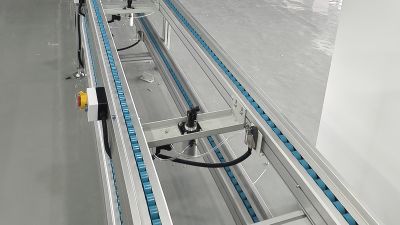
Its specialized transmission structure accelerates material flow and supports precise stopping at workstation positions. Combined with tooling plates, the conveyor can move products between automated processes for lifting, transferring, and testing, helping equipment operate in a coordinated sequence. This arrangement is suited to standardized lines where repeatable positioning and steady circulation are important to production efficiency.

For large-scale factories, a high-speed conveyor can help reduce delays between operations without sacrificing controlled handling. A robust chain system also provides a practical foundation for integrating additional automated equipment as production requirements change. These capabilities make 2.5x speed chain conveyors a relevant option for manufacturers seeking to streamline assembly workflows and maintain consistent line performance.

FAQS

How does a 24 VDC motor-driven roller system move cartons?

Selected rollers power defined zones. Sensors detect cartons and start or stop each zone. A carton can pause while another waits upstream.

Can zoned control reduce package crowding?

It can help manage uneven flow and reduce unnecessary roller movement. Poorly adjusted spacing may still leave cartons stalled or too close together.

What should be checked before choosing a roller conveyor?

Measure carton sizes, package weights, throughput, and stop-start frequency. Match roller spacing to the smallest carton. Test with real boxes.

Why might photoelectric sensors miss a carton?

Glossy wrapping, gaps between cartons, dust, or loose labels can affect detection. Test sensor placement with the actual packages.

Are chain-driven live rollers suitable for heavy loads?

They can move dense cartons, totes, and pallet loads using a positive drive. Check load weight, base, roller pitch, conveyor width, and speed.

What maintenance do chain-driven rollers need?

Inspect chain alignment and lubrication, and keep the chain guarded. Small alignment problems can become persistent trouble. Easy to overlook.

When might a flexible roller line be useful?

It can adapt to temporary work areas or changing layouts. Coatings and materials should suit the packages and operating conditions.

Does a quiet short test prove a system will perform all day?

No. Heat, dust, changing carton sizes, and loose labels may affect a full shift. Measure actual flow and adjust one zone at a time.

Conclusion

Roller Conveyor systems move products efficiently by supporting loads on a series of rollers. A sound design follows established dimensional and support principles, including the guideline that a conveyed item should rest on at least three rollers at once. Gravity models use a slight slope, commonly around 1–3%, so goods travel without powered drives. For controlled package flow, 24 VDC motor-driven rollers can operate in zones, while belt-driven live roller systems provide continuous motion for loads of varying sizes.

Different applications call for different drive and layout options. Chain-driven live rollers offer positive movement for heavier loads, and accumulation designs can create zero-pressure zones to help prevent packages from pressing against one another. Flexible and curved roller sections can adapt to changing layouts and guide items through turns, including 90-degree routes. By matching the conveyor type to load weight, package dimensions, flow needs, and available space, facilities can build a practical, adaptable material-handling system.
Liam

Liam

Liam is a skilled marketing professional at a leading automation equipment enterprise, where he plays a pivotal role in communicating the value of the company's integrated services. With a deep understanding of industrial automation, he expertly covers topics related to professional design,......
Previous Who Are the Top Chain Conveyor Manufacturers in China?