People often ask me, 'What's the best continuous elevator out there?' Honestly, the right answer really depends on things like what material you're handling, how much it needs to carry, your building's height, and how you plan to operate it. It’s not just about picking something straight off a catalog — a continuous elevator should fit seamlessly into your entire handling system. For example, a grain processor might need something gentle to move the product, while a distribution center might be more interested in speed and a space-efficient setup. Basically, matching the fit is key.
Many seasoned buyers look at a bunch of factors: how the product flows through the system, the spacing of buckets, how precise the discharge is, noise levels, how easy it is to clean, and how long maintenance takes. They also consider things like motor efficiency, safety features like emergency stops, guarding, corrosion resistance, and whether spare parts are readily available. For instance, a Slat Chain Elevator is great for steady, heavy-duty materials that need controlled movement. On the other hand, a lighter-duty continuous elevator works well for handling cartons, packaged goods, or smaller loads without any fuss. And if you’re dealing with particularly demanding applications, a heavy-duty version with stronger chains, frames, and bearings might be the way to go.
Depending on what you need, you might even look into multi-layer models to save vertical space or high-speed elevators if throughput is super important. Fixed models are perfect if your plant layout is pretty stable and routes are predictable. But here’s a tip — just because a model is fast doesn’t mean it’s the best choice for you. You gotta consider all the factors.
Good suppliers are crucial, too. They should provide load calculations, detailed layout drawings, test reports, guidance for installation, and clear inspection procedures. It’s also smart to ask for references from similar industries and to see how these elevators perform in real-world conditions. Getting independent opinions can really boost your confidence, especially if your plant is in a region with different standards or expectations. Certifications are nice, but ultimately, what matters most is how the equipment performs in daily use.
Keep in mind, some details might only become clear after the supplier looks into specifics like your product’s dimensions, moisture level, temperature, and how consistent your feeding process is. That’s totally normal. A thorough selection process leaves space for testing, adjustments, and fine-tuning. The best continuous elevator is the one that keeps performing reliably over time, offers safe access, is easy to maintain, and provides real value for years to come.
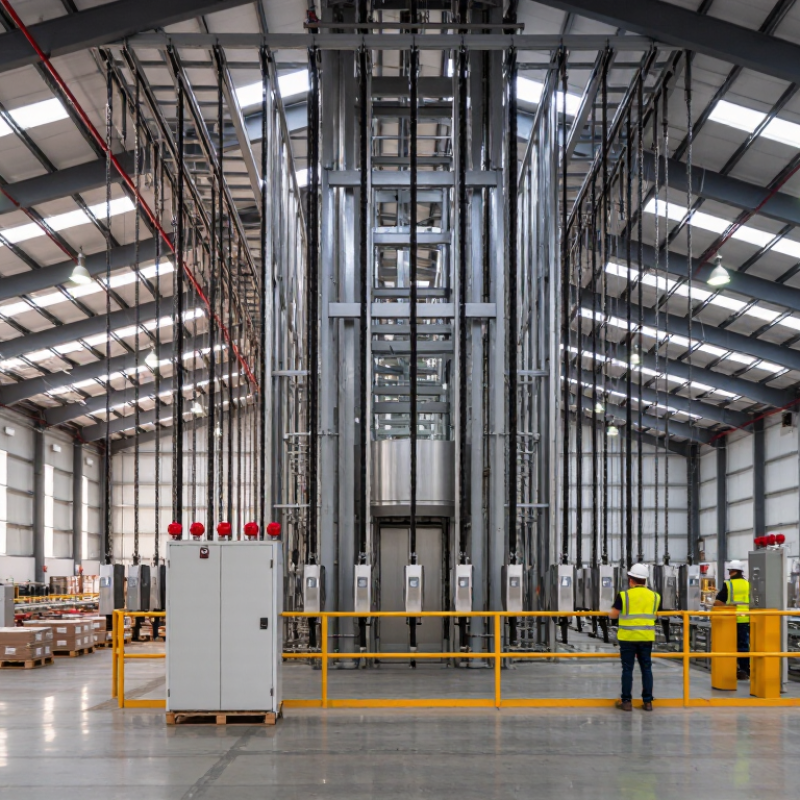
A continuous elevator moves goods between levels without stopping for every transfer. Its buckets, pallets, platforms, or belts circulate continuously around a vertical path. A motor drives the chain, while guides maintain alignment and control product spacing. In a Bucket Continuous Elevator, individual containers carry grain, components, or packaged goods upward. A Pallet Continuous Elevator supports cartons on linked platforms. The choice depends on load shape, speed, and discharge accuracy.
A Vertical Continuous Elevator uses compact lifting compartments for repeated floor-to-floor movement. A Frame-type Elevator offers an open structure for inspection and cleaning. An Enclosed Elevator adds guarding against dust, contact, and falling materials. In humid or delicate environments, a Mesh Belt Continuous Elevator can improve ventilation and drainage. The operating principle remains similar, but loading, unloading, and safety controls differ.
The MHI 2024 Annual Industry Report found that 55% of supply chain professionals planned to increase technology investment. That pressure encourages automated vertical transport, especially where floor space is limited. Still, capacity figures can mislead. A rated load is not the same as stable throughput. Product spacing, acceleration, operator access, and emergency stops affect real performance. During site checks, engineers should measure peak demand, not average demand. They should also review noise, guarding, cleaning time, and maintenance access. Small cartons may shift on a poorly selected pallet. That detail matters. A reliable specification needs verified dimensions, weight ranges, discharge heights, and local electrical requirements before purchase.
What Is the Best Continuous Elevator for Global Buyers?
The best Continuous elevator depends on material, discharge height, capacity, and building layout. A Vertical continuous elevator suits grains, powders, and boxed goods moving straight upward. Its compact footprint helps factories with limited floor space. A Z-type continuous elevator collects products from one level, rises vertically, then discharges horizontally. It fits packaging lines and multi-floor warehouses. A C-type continuous elevator follows a C-shaped route, supporting gentle loading and unloading. This design can reduce product impacts during transfers. A Bucket elevator remains practical for bulk materials, especially grain, fertilizer, and dry aggregates. Bucket size, belt speed, and casing clearance need careful matching.
The FAO Food Loss Index reports that 13.2% of food is lost globally between harvest and retail. Poor conveying can increase damage, spillage, and contamination risks. That figure makes elevator design a process decision, not merely a lifting decision. Buyers should request capacity curves, motor-load data, noise readings, and cleaning access. EN 619 and ISO 12100 provide useful safety and machinery-design references for risk assessment. Local electrical requirements still differ. Do not assume one certificate works everywhere. In field evaluations, I have seen technically strong elevators fail because the inlet was poorly aligned. A quiet machine can still waste product. This is where specifications need honest review. Temperature, dust, moisture, and fragile surfaces may change the preferred type. Sometimes, a slower system performs better.
Global buyers should match capacity with real loads, not optimistic estimates. A lift rated for 1,000 kilograms may perform poorly when pallets shift during loading. In a warehouse, measure pallet width, trolley clearance, and stopping space. These details affect daily safety and productivity. The choice between an Enclosed reciprocating elevator and an Open-type reciprocating elevator depends on the environment. Enclosed cabins protect goods from dust, while open platforms offer faster visual access.
Speed matters, but maximum speed is not always practical. Fast travel can increase vibration, noise, and positioning errors. For fragile cartons, controlled acceleration may be more valuable than shorter travel time. A Chain-driven reciprocating elevator often suits heavy-duty movement and repeated cycles. A Belt-driven reciprocating elevator can provide smooth operation when loads are moderate. Buyers should compare cycle time under actual working conditions. Small delays accumulate.
Lifting height changes the equipment’s structural and maintenance demands. A 4-meter rise may need less guidance and power than a 10-meter installation. At greater heights, check shaft alignment, platform stability, emergency stopping, and access for inspection. Field checks often reveal problems that specification sheets miss. Real projects rarely match the clean assumptions in early drawings. A careful buyer should request load charts, duty-cycle data, installation limits, and service procedures. One overlooked detail can change the preferred design.
For global buyers, a continuous elevator must match the material before capacity becomes the priority. Carbon steel suits dry grain, pellets, and moderate temperatures. Stainless steel is safer for humid, corrosive, or hygienic environments. Abrasion-resistant liners help with sand, minerals, and sharp particles. Polymer buckets reduce sticking, but they may soften under heat. Small details matter.
Operating conditions need measured values, not guesses. Record bulk density, moisture, particle size, temperature, and required throughput. The CEMA Belt Conveyors for Bulk Materials, 7th edition, links elevator performance to bucket spacing, belt speed, loading, and fill level. Overfilling can increase spillage and belt stress. Underfilling wastes energy. It sounds obvious, yet specifications often omit moisture changes during the season.
Energy deserves attention. The U.S. Department of Energy reports that motor-driven equipment uses about 68% of industrial electricity. Buyers should request motor efficiency, startup current, and standby consumption data. Dust control is equally important. OSHA identifies combustible grain dust as a serious fire and explosion hazard in handling facilities. Use sealed transfer points, appropriate ventilation, inspection access, and locally compliant electrical protection. No design is perfect. A supplier’s laboratory result may not represent sticky material in a cold, humid warehouse. Request a material trial using the buyer’s actual feedstock.
The best continuous elevator depends on the conveyed material, required capacity, lift height, temperature, moisture, abrasiveness, hygiene requirements, and local safety regulations. The comparison below provides practical selection guidance for global buyers without referring to specific brands or manufacturers.
| Selection Dimension | Typical Options or Range | Recommended Material or Operating Condition | Buyer Considerations |
|---|---|---|---|
| Elevator configuration | Continuous bucket, pendulum bucket, or overlapping bucket design | Continuous bucket designs are suitable for controlled, low-impact handling of powders, grains, pellets, and fragile bulk solids. | Choose the configuration according to particle fragility, discharge behavior, required capacity, and available headroom. |
| Conveyed material | Dry bulk solids, powders, granules, pellets, seeds, food ingredients, minerals, and chemicals | Free-flowing materials with a stable bulk density and predictable discharge characteristics generally provide the best performance. | Provide particle-size distribution, bulk density, angle of repose, moisture content, abrasiveness, and flowability before sizing. |
| Capacity | Commonly specified from approximately 5 to 200 tonnes per hour, depending on material and equipment size | Use the required continuous throughput rather than the short-term peak rate as the primary sizing basis. | Confirm whether capacity is measured by mass or volume. Convert using the actual bulk density of the conveyed product. |
| Lift height | Often designed from about 5 to 60 m; taller installations may require additional engineering | Use a rigid casing, correctly tensioned belt or chain, and suitable inspection access for high-lift applications. | Check building height, maintenance access, foundation loads, wind loads for outdoor installations, and transport limitations. |
| Bucket material | Carbon steel, stainless steel, polymer, or reinforced composite | Use stainless steel for corrosion-sensitive or hygienic applications; abrasion-resistant steel or reinforced polymer for abrasive products. | Evaluate corrosion, impact, temperature, cleanability, static electricity, and compatibility with the product. |
| Casing material | Painted carbon steel, galvanized steel, or stainless steel | Stainless steel is preferred for washdown, corrosive atmospheres, and food or pharmaceutical environments. | Specify corrosion protection, sealing quality, access doors, inspection windows, and surface-finish requirements. |
| Drive system | Geared motor with direct coupling or chain-and-sprocket drive; variable-frequency control where needed | Select a drive with sufficient starting torque and a service factor appropriate for continuous duty. | Check motor voltage, frequency, efficiency class, enclosure rating, local electrical standards, and spare-parts availability. |
| Operating speed | Usually lower than high-speed centrifugal bucket elevators; exact speed depends on bucket spacing and product behavior | Lower, controlled speeds reduce product damage, dust generation, and discharge impact. | Do not select speed alone. Confirm bucket fill level, discharge geometry, particle degradation, and motor power together. |
| Temperature | Ambient service is common; elevated-temperature designs may handle approximately 80–150 °C depending on components | Use heat-resistant belts, chains, seals, lubricants, bearings, and buckets when conveying hot material. | State both material temperature and ambient temperature. Allow for heat expansion and protect operators from hot surfaces. |
| Moisture and humidity | Dry to moderately moist materials; sticky or wet materials require special design | Provide sealed housings, drainage, corrosion-resistant parts, and anti-build-up features for humid or damp conditions. | Moisture can reduce flowability, increase adhesion, cause plugging, and accelerate corrosion. |
| Abrasiveness | Low, medium, or high, based on hardness, sharpness, and concentration of abrasive particles | Use wear-resistant liners, reinforced buckets, hardened chain components, and replaceable wear parts for abrasive products. | Request expected wear-life data and identify all components exposed to the material stream. |
| Food and pharmaceutical hygiene | Sanitary construction with smooth, accessible, cleanable surfaces | Use suitable stainless steel, hygienic welds, food-compatible seals, and designs that minimize product retention. | Confirm applicable local regulations, cleaning method, allergen-control requirements, and required documentation. |
| Dust and explosion risk | Relevant for combustible dusts such as grain, flour, sugar, starch, coal, and some chemical powders | Use dust-tight construction, bonding and grounding, suitable electrical equipment, monitoring devices, and engineered explosion protection. | Obtain dust explosibility data and comply with the applicable site and country safety requirements. A qualified safety engineer should approve the design. |
| Fragile-product handling | Low-impact conveying for whole grains, snack pellets, seeds, coated products, and similar materials | Use gentle acceleration, moderate speed, full but controlled bucket loading, and cushioned transfer points. | Measure breakage, fines generation, and product degradation during commissioning rather than relying only on theoretical capacity. |
| Noise and vibration | Affected by speed, alignment, bearings, chain or belt condition, and material loading | Install on a rigid, level foundation with correct alignment, guarding, lubrication, and vibration monitoring where appropriate. | Specify allowable workplace noise, maintenance access, and alarms for belt slip, misalignment, bearing temperature, and overload. |
| Weather and installation location | Indoor, outdoor, coastal, cold, hot, humid, or dusty environments | Outdoor installations need weatherproof covers, corrosion protection, drainage, suitable electrical enclosures, and protection from freezing. | Consider local wind, rainfall, snow, salt exposure, ambient temperature, seismic conditions, and maintenance access. |
| Maintenance requirements | Routine inspection of buckets, belt or chain, sprockets, bearings, seals, fasteners, and drive components | Choose modular access panels, replaceable wear parts, practical lubrication points, and readily available standard components. | Ask for preventive-maintenance intervals, recommended spare parts, inspection procedures, and estimated downtime. |
| Energy efficiency | Influenced by lift height, throughput, mechanical efficiency, speed, and operating schedule | Use an accurately sized motor, efficient transmission, correct tension, low-friction bearings, and variable-speed control when process demand varies. | Compare power consumption per tonne conveyed rather than motor rating alone. |
| Global procurement and compliance | Electrical, machinery, pressure-relief, food-contact, and workplace-safety requirements vary by destination | Specify the destination country, site regulations, electrical supply, documentation language, and inspection requirements at quotation stage. | Confirm drawings, manuals, test records, certificates, packaging, shipping dimensions, commissioning support, and after-sales service coverage. |
| Information to Provide | Why It Matters |
|---|---|
| Material name, particle size, bulk density, moisture, temperature, and abrasiveness | These properties determine bucket volume, loading method, materials of construction, power, and wear protection. |
| Required capacity, operating hours, and peak demand | They establish the design throughput, duty cycle, motor size, and acceptable operating reserve. |
| Inlet and outlet elevations, layout drawings, and available footprint | They determine elevator height, casing arrangement, access requirements, and connection points. |
| Cleaning method, hygiene level, and contamination limits | They guide stainless-steel selection, sealing, drainage, surface finish, and access-panel design. |
| Dust classification, hazardous-area requirements, and local regulations | They affect grounding, electrical equipment, monitoring, venting, isolation, and explosion-protection measures. |
| Preferred delivery terms, installation location, power supply, and service expectations | They influence packaging, shipping, motor configuration, documentation, commissioning, and lifecycle cost. |
For global buyers, a Reciprocating lifting elevator must satisfy more than lifting capacity. Safety begins with a documented risk assessment under ISO 12100. The design should also consider ISO 13849-1 for control-system reliability and IEC 60204-1 for electrical equipment. Guard doors, interlocks, emergency stops, and overload protection need practical testing. A Floor reciprocating elevator should stop safely when a gate opens, even with an uneven pallet.
The International Labour Organization estimated nearly three million work-related deaths and 395 million non-fatal injuries in 2023. These figures make routine safety checks commercially important, not merely administrative. For a Cargo reciprocating elevator or Reciprocating lift, buyers should request load-test records, inspection intervals, weld-quality documents, and traceable component certificates. EN 1570-1 may apply to lifting tables, while ASME A17.1/CSA B44 can matter for elevator installations in North America. Local authority approval still decides final acceptance.
A Vertical reciprocating lifting conveyor may appear simple. It is not. Check platform deflection, brake response, noise, travel limits, and emergency lowering during factory trials. Ask for the technical file and conformity assessment route. Documentation can be weak.
Real experience often reveals gaps. A supplier may meet one standard but miss site-specific fire, seismic, or access requirements. Buyers should compare standards, test evidence, and maintenance support together, rather than trusting a compliance label alone.
Choosing the best continuous elevator requires more than comparing the lowest quotation. Global buyers should examine supplier experience, engineering records, and after-sales reliability. Ask for application references with similar load, height, operating hours, and product type. A supplier handling cartons may not understand dusty bulk materials or temperature-sensitive goods.
Request a detailed cost breakdown. Include equipment, controls, guarding, installation, freight, taxes, commissioning, training, and spare parts. Compare energy use and scheduled maintenance over five years. A cheaper unit can become expensive when belts, sensors, or drive components are difficult to source. Check whether drawings, manuals, test reports, and risk assessments are included. These documents reveal professional discipline.
Support quality often decides whether production stays stable. Confirm response times, remote diagnostic methods, technician coverage, and spare-part availability in your region. Ask how the supplier manages emergency repairs across time zones. During one project review, an assumed installation schedule changed after the site required extra structural work. That mistake was preventable. Buyers should share accurate floor plans, access limits, power details, and local certification requirements early. Suppliers should respond with clear exclusions, realistic delivery dates, and measurable acceptance tests. Do not accept vague promises. Ask what happens after commissioning, when the first fault occurs.
Continuous bucket hoists provide an efficient solution for the vertical and inclined transportation of grain, mining materials, and building products. Designed with continuously operating chains, belts, and buckets, these systems move bulk materials smoothly while maintaining a stable flow. Their enclosed conveying structure helps reduce material loss, dust generation, and transfer interruptions, making them suitable for demanding industrial environments.
Manufactured in China, our continuous bucket hoists are produced under controlled factory standards with advanced processing technology and careful quality inspection. The equipment can be configured for different lifting heights, capacities, material characteristics, and installation layouts. Durable components and robust construction support reliable operation when handling grain, mineral products, cement-related materials, aggregates, and other bulk goods.
As an experienced China supplier and factory, we provide practical equipment solutions for both heavy-duty lifting and fast material handling. Options may include customized bucket sizes, chain or belt configurations, wear-resistant materials, variable feeding arrangements, and safety monitoring systems. These flexible designs help operators integrate the hoist into existing production lines, storage facilities, processing plants, and construction-material systems while simplifying maintenance and daily operation.
A vertical elevator moves grains, powders, or cartons straight upward. Its compact footprint suits factories with limited floor space. Measure twice.
Choose a Z-type model when products enter at one level and discharge horizontally elsewhere. It fits packaging lines and multi-floor warehouses. Layout matters.
A C-type elevator follows a curved route for gentler loading and unloading. It can reduce impacts on fragile products during transfers. Not always.
Bucket elevators remain practical for grains and dry aggregates. Match bucket size, belt speed, and casing clearance carefully. Small gaps matter.
Request capacity curves, motor-load data, noise readings, and cleaning-access drawings. Also review temperature, dust, moisture, and product-surface requirements. Details matter.
Compare equipment, controls, guarding, installation, freight, taxes, commissioning, training, and spare parts. A low purchase price may hide higher maintenance costs. Cheap is not always cheaper.
Confirm response times, remote diagnosis, regional technicians, and spare-part availability. Ask how emergency repairs work across time zones. Support matters.
Share accurate floor plans, access limits, power details, product data, and local certification requirements. Poor inlet alignment can cause failures, even with a quiet machine. That mistake is preventable.
Compare five-year energy use, scheduled maintenance, belt replacement, sensor access, and drive-component availability. Request clear acceptance tests and realistic delivery dates. Vague promises need review.
A Continuous Elevator is a vertical material-handling system designed to move products, components, or bulk materials steadily between different levels. Its operating principle typically combines connected carriers, buckets, platforms, or belts with a drive and control system, allowing consistent lifting with limited floor space. Global buyers should compare bucket, platform, vertical conveyor, and specialized configurations according to the material, required throughput, lifting height, speed, and loading or discharge method. Fragile, abrasive, hot, dusty, or moisture-sensitive materials may require different construction and protection features.
Selection should also consider operating temperature, humidity, hygiene requirements, available installation space, maintenance access, energy use, and integration with existing equipment. Safety guards, emergency stops, overload protection, inspection points, and reliable controls are essential, while applicable international quality, electrical, machinery, and workplace-safety requirements should be verified for the target market. To compare suppliers effectively, buyers should request clear technical specifications, lifecycle cost estimates, delivery terms, spare-parts availability, installation guidance, training, warranty coverage, and responsive after-sales support. The best Continuous Elevator is therefore the one that combines suitable performance, safe operation, durable construction, compliance, and dependable long-term service.